

About Lumex

We were founded on a complaint about our own industry.

Lumex Engineering was established in Sydney in 2023 by two Directors who had spent their careers watching the same failure repeat: consultancies delivering drawings instead of delivering confidence.

Sydney central business district at sunrise
Why Lumex exists

Drawings are the output. Confidence is the product.

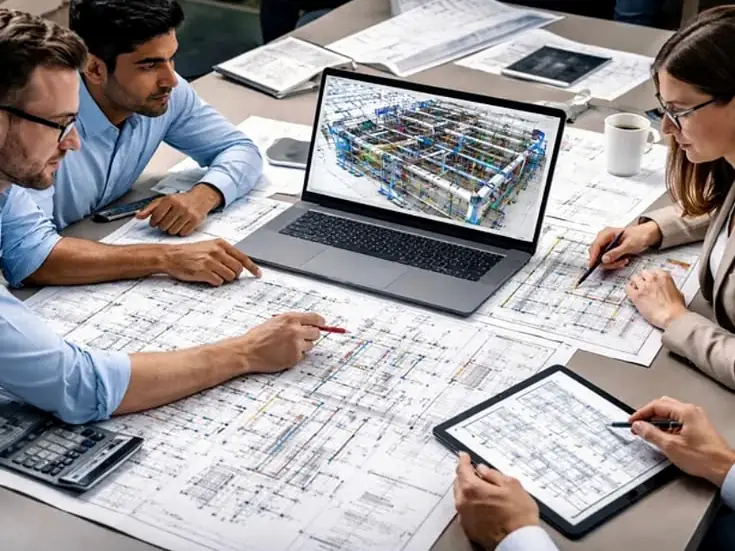
Multidisciplinary design coordination against a federated model

On too many projects the client ends up doing the consultant's job — chasing responses, coordinating between disciplines, and carrying risk that should have been absorbed upstream.

That is not a shortage of technical ability. It is what happens when a practice is organised around producing documents rather than resolving problems: the design is issued, it is technically defensible, and it does not survive contact with a site.

Lumex is built the other way round. The measure of our work is not the drawing set — it is whether the project got easier because we were on it. Fewer RFIs, fewer variations, and a builder who can price what we issued.

If a client has to chase us, we have failed. That is a value with a test attached, which is the only kind worth publishing.

Vision

To become one of Australia's most trusted multidisciplinary engineering consultancies, and to take that standard international.

Trust-led rather than scale-led. Growth is the by-product of being the consultancy clients call back, not the objective.

The position

Engineering fails at the joins far more often than it fails inside a discipline.

That is where we concentrate. Coordination between disciplines, decisions taken before anyone has checked whether they can be built, and the interfaces every consultant assumes someone else is holding.

What we hold to

Six positions, each with a test attached.

A value that cannot be failed is not a value. Each of these can be checked against a project.

Buildability

Every design decision is tested against how it will actually be installed, by whom, in what sequence, and with what access.

Coordination

Conflict is resolved in the model, before documentation is issued. The alternative is resolving it on site at ten times the cost.

Accountability

If a client has to chase us, we have failed. Problems belong to everyone; excuses belong to no one.

Technical rigour

Compliance is the floor. Constructability, maintainability and long-term value carry equal weight to meeting the Standard.

Commercial sense

The simplest practical solution that delivers the best outcome, not the most sophisticated one available.

Clarity

If a client cannot understand the recommendation, the recommendation is not finished.

How we work

Every consultancy says it is easy to work with. Here is what ours actually does.

Most consultancies describe their approach. Very few describe their process — what happens in the first week, who reviews what before it is issued, and what you receive at each stage. This is ours, in the order it happens.

We read the constraint before we price the work

Before a fee proposal is issued we ask for the consent, the architectural set and the programme. A proposal written against the actual constraint is worth more to you than one written against a floor area — and it means the first conversation is about the project, not about scope inclusions.

One team, one set of assumptions

Every discipline you engage us for is delivered by the same team working to the same model and the same design criteria. You do not coordinate between our disciplines, and you do not receive two answers to the same question.

The hard decisions are made at concept

Plant space, riser allocation, ceiling depth, drainage falls, substation siting and fire water storage are all decided in the first weeks and all extremely expensive to revisit. We resolve them before the plan is fixed and we hold the figures through documentation.

Coordination runs on a cycle, with owners

Clash detection is scheduled, every issue is assigned to a person and a date, and the closing-out position is reported. What matters is not how many clashes were found — it is how many reached site.

Documentation is checked before it is issued

Every package passes an internal engineering and documentation review before issue. Nothing leaves this office because a deadline arrived.

We answer inside a business day

Every enquiry and every RFI receives a response within one business day. If an answer needs more time, you get the timeframe within the day rather than silence. Fee proposals are generally issued within three to five business days, depending on complexity and the documentation provided.

We stay on the job through construction

Shop drawing review, site inspection, commissioning witness and certification are scoped explicitly. The consultant who designed it is the consultant who answers the questions about it.

Leadership

Two Directors, presented as equals because that is how the business runs.

Both Directors are engaged on project delivery. The Director you meet is the Director on your project.

Nour Kandil, Founder & Director, Lumex Engineering

Nour Kandil

Founder & Director · B.Eng (Mechanical, Honours)

MIEAustCPEngNERDBPFPAA FSAGSAP

Nour founded Lumex after a decade in Australian building services, progressing from graduate mechanical engineer through project engineer and design manager to National Engineering Manager. He established the practice on a specific diagnosis: consultancies had drifted into delivering drawings rather than delivering confidence, leaving clients to coordinate disciplines themselves and absorb risk the consultant should have carried.

“Engineering is about solving problems. Drawings are how the solution gets communicated. Theory identifies possibilities; experience determines which one is right.”

Ahmed Ismail, Founder & Director, Lumex Engineering

Ahmed Ismail

Founder & Director · B.Eng (Honours)

MIEAustCPEngNERDBPRPEQ

Ahmed leads engineering delivery and technical quality across the practice. His focus is the part of a project most consultancies treat as administration and Lumex treats as engineering: how a design is documented, how disciplines are coordinated against one model, and how a package is checked before it is issued. He holds registration in both New South Wales and Queensland, and works across the disciplines rather than inside one of them.

“A design is only as good as the documentation that carries it to site. Coordination is not a stage at the end of a project — it is the discipline that runs through all of it.”
Where we operate

Two regions. One engineering standard.

Lumex operates from Sydney and Cairo, serving clients across Australia, Egypt and the broader Middle East. Each office is being developed as a regional engineering business, supported by shared systems, technical collaboration and consistent quality standards.

The two practices run on the same design criteria, the same documentation standards and the same review gates. An engineer moving between them is working to one set of assumptions, which is the same argument we make about disciplines on a single project.

On Australian projects, design responsibility, certification and statutory registration sit with Australian-registered engineers, as they must.

Sydney central business district at sunrise
SydneyAustralia

Serves Australia. Mechanical, electrical, hydraulic, fire, passive fire, civil, ESD, CFD, digital engineering and ASP Level 3 electrical.

Cairo on the Nile
CairoEgypt

Serves Egypt and supports the growing Lumex presence across the broader Middle East.

People

Develop great people before developing a great business.

Engineers here get project exposure early, and direct access to the Directors running the job. That is how the practice is structured.

Responsibility is delegated and accountability is expected. Problems belong to everyone; excuses belong to no one.

Working at Lumex

Ask us something specific.

A short call with a Director is usually more useful than a capability statement. Fifteen minutes, no proposal attached.