Sustainability targets met by engineering, not by allowance.
Sustainability requirements are met twice on most projects — once on paper for the consent, and again in reality when the building is operating and the numbers do not match. The gap is usually caused by treating ESD as a compliance report produced after the services design rather than as an input to it. We run the modelling early enough to change the design, which is the only point at which modelling saves money.
Scope, by project stage.
Stated by stage so you can see exactly what is included at the point you are engaging us — and what is not.
Concept and feasibility
- Target pathway assessment — BASIX, Section J, NABERS, Green Star
- Early facade and services trade-off modelling
- Capital versus operating cost comparison of the credible options
- Identification of the credits or provisions that are genuinely achievable
Development Application
- BASIX certificate where applicable
- ESD statement to council requirements
- Preliminary energy modelling
- Sustainability strategy documentation
Construction Certificate
- NCC Section J compliance — elemental or JV3 performance pathway
- Detailed energy modelling and thermal simulation
- Green Star or NABERS documentation support
- Commitment agreement input where a NABERS rating is contracted
Construction phase
- Verification of installed performance against the modelled assumptions
- Substitution assessment for specification changes
- Commissioning and tuning input
- Post-occupancy rating support
Three positions we hold on ecologically sustainable design.
These are the decisions that determine whether the package works. They are made early, and they are the ones we will argue about.
Model early enough to change something
Energy modelling produced after the facade and the plant are fixed can only report. Modelling produced during concept can move a glazing ratio, a shading decision or a plant selection — which is where the capital and operating savings actually come from.
A performance pathway is a commercial tool
A JV3 or equivalent performance pathway is often worth more than the modelling fee, because it can release facade or plant capital that the elemental provisions would otherwise lock in. We assess whether it is worth doing rather than defaulting either way.
Do not chase credits that will not be achieved
A rating strategy built on credits that quietly fail during construction costs the project twice. We prefer a shorter list of credits that survive to certification over a longer list that reads well at DA.
Sectors and framework.
Compliance is the floor. Constructability, maintainability and long-term value carry equal weight.
Sectors
Design framework
- NCC Volume One Section J and JV3
- BASIX (NSW)
- NABERS Energy and Water
- Green Star Buildings
- ASHRAE 90.1 Appendix G where applicable
Recent projects.
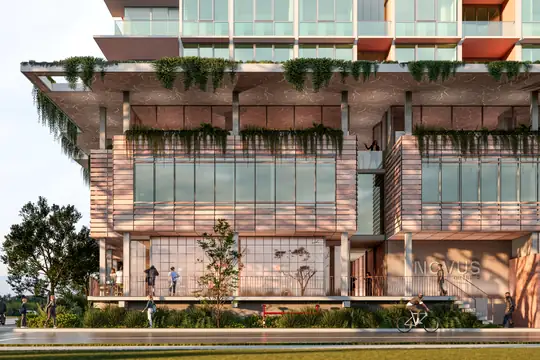
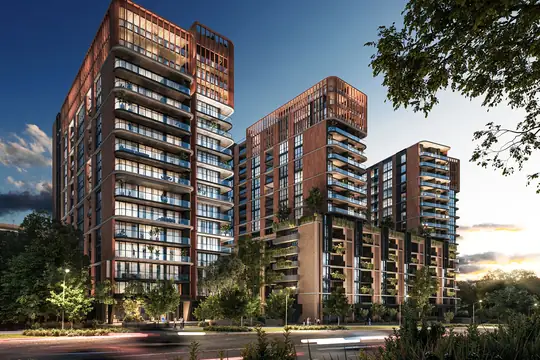
Residential, education, student accommodation, hospitality, alpine and industrial projects delivered across Australia.
All projects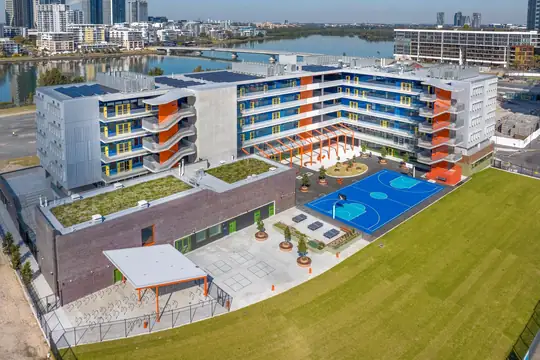
Ecologically Sustainable Design (ESD).
Marked up as FAQPage structured data — the correct structure for AI answer engines as well as for search.
Ecologically Sustainable Design. It is the term used in Australian practice and in most council DCP requirements.
It depends on what the elemental provisions are costing the project. Where they are driving facade specification or plant capacity beyond what the building needs, a performance pathway usually pays for itself. We assess it before you commit to either.
Yes, including the design-stage modelling, the services design implications and the tuning period support that determines whether the committed rating is actually achieved.
Yes, for residential projects where BASIX applies, alongside the Section J documentation for the non-residential components of mixed-use developments.
Usually engaged alongside this.
Mechanical Engineering
HVAC, ventilation and thermal comfort designed for buildability, efficient plant space and long-term performance.
Electrical Engineering
Power, lighting, distribution and communications designed for capacity, safety and future flexibility.
CFD Modelling
Computational fluid dynamics for smoke, ventilation, thermal comfort and carpark exhaust — evidence where assumption is not enough.
Have a project that needs ecologically sustainable design?
Tell us the scope, the stage and the deadline. We will come back with a clear fee proposal.